

Picking a fence in NZ usually comes down to a choice between two materials. Aluminium, which dominates pool, boundary and modern residential fencing, and steel, which owns commercial, security, rural and colour steel fencing. Both work. Both last. They do not suit the same jobs, and the wrong choice shows up as either a fence that rusts in five years or a fence that cost twice what the project needed.
This guide is the short version of the conversation our sales team has with builders, homeowners, pool installers and facility managers every week. It covers the practical differences between aluminium and steel fencing, how each handles NZ weather, what they actually cost over ten years, and which one fits which job.
The fast answer: For residential boundary fences, pool fences and modern home fencing in NZ, aluminium almost always wins on lifespan, maintenance and finish. For commercial security, rural boundaries, industrial sites and heavy duty gate structures, steel wins on strength and cost per metre. Browse the SD Aluminium fence range or talk to the team for a tailored quote.
What “aluminium fencing” and “steel fencing” actually mean in NZ
Aluminium fencing in NZ is almost always a powder coated aluminium panel or paling system, built from extruded aluminium rails and pickets, and finished in black, charcoal, white or a colour match. It is supplied as modular panels between aluminium posts, with matching pedestrian and driveway gates. Pool variants are height and gap compliant under the Fencing of Swimming Pools Act.
Steel fencing covers a wider field. Galvanised weld mesh on galvanised posts is the standard for commercial security and industrial boundaries. Colour steel and Colorsteel profile sheet is common for rural and lifestyle block boundaries. Galvanised tube and angle steel fit heavy duty gate frames and industrial balustrade. Chain wire and barbed wire remain the workhorse for rural and agricultural boundaries.
When someone says “steel fence” in a residential context in NZ, they usually mean colour steel profile sheet or a powder coated mild steel tube fence. When they say it in a commercial context, they usually mean galvanised mesh or a heavy galvanised weld panel. The material behaves differently in each of those cases, so the comparison has to stay concrete, not abstract.
Corrosion and NZ weather
This is the single biggest reason NZ residential buyers pick aluminium. Aluminium does not rust. It oxidises on the surface, which protects the metal underneath, and a powder coated aluminium fence will hold its finish for 20 to 25 years in most NZ climates. On the coast the oxide layer is doing heavy lifting, and the finish still typically runs 15 to 20 years before it needs refinishing.
Steel rusts. Galvanising and powder coating slow it down dramatically, but any nick, scratch or exposed cut edge is where rust starts, and once it starts, it spreads. Galvanised steel fencing in NZ lifestyle and rural sites typically runs 15 to 20 years. On the coast, cut ends and weld points are the first to go, and full corrosion can set in at 10 to 15 years without regular touch up.
Colour steel profile sheet fencing performs better than raw galvanised mild steel because the factory applied zinc aluminium coat plus the colour layer is more robust. Expect 15 to 20 years on the coast, 20 to 25 inland, before visible corrosion at the panel edges.
The NZ coastline is unusually salty by global standards. Any fence within 500m of the sea should be specified with corrosion in mind, not just as a stylistic pick. This is where aluminium moves from “nicer finish” to “the right material for the climate.”
Cost: material, install and ten year total
Upfront, steel is almost always cheaper per linear metre than aluminium. A galvanised weld mesh panel run is typically 15 to 30 percent cheaper than an equivalent aluminium paling fence. Colour steel profile sheet fencing is cheaper again than weld mesh for the same coverage. This is the main reason steel holds onto commercial and rural projects.
Install cost is closer than the material numbers suggest. Aluminium panels are lighter, faster to set, and do not need specialist welding or on site cutting. Steel, especially heavy gauge or custom cut panels, often needs a welder and a grinder on site. On a small to mid size residential run, aluminium usually installs 25 to 40 percent faster than a comparable steel build.
The ten year total cost usually flips the picture. A powder coated aluminium fence needs no touch up, no rust treatment and no paint. A steel fence in NZ usually needs at least one rust touch up, one colour refresh, and potentially a full refinish inside ten years. Once that recurring cost is factored in, aluminium is often cheaper over a decade, especially on coastal sites.
Head to head: aluminium vs steel fencing
| Factor | Aluminium fencing | Steel fencing |
|---|---|---|
| Upfront cost per metre | Higher | Lower (15 to 30 percent cheaper on like for like) |
| Install speed | Fast (panels modular, bolt together) | Slower for mesh and tube, often needs welding |
| Rust / corrosion | Does not rust, holds finish 20 plus years | Rusts at cuts and damage, 10 to 20 years typical |
| Maintenance | Wash with water, no refinishing | Touch up, recoat, rust treatment every 5 to 10 years |
| Strength | Good for residential, pool, light commercial | Higher raw strength, suits security and rural |
| Weight | Light, easy to handle | Heavy, often needs machinery for large runs |
| Finish options | Powder coat, any RAL colour, anodised | Galvanised, powder coat, Colorsteel profile |
| Pool fence compliance | Most common NZ pool fence material | Rare for residential pools |
| Best residential use | Boundary, pool, front fence, modern design | Rural boundary, security, heavy gates |
| 10 year total cost | Lower once maintenance factored in | Higher due to refinishing cycle |
When aluminium is the right call
Pool fencing
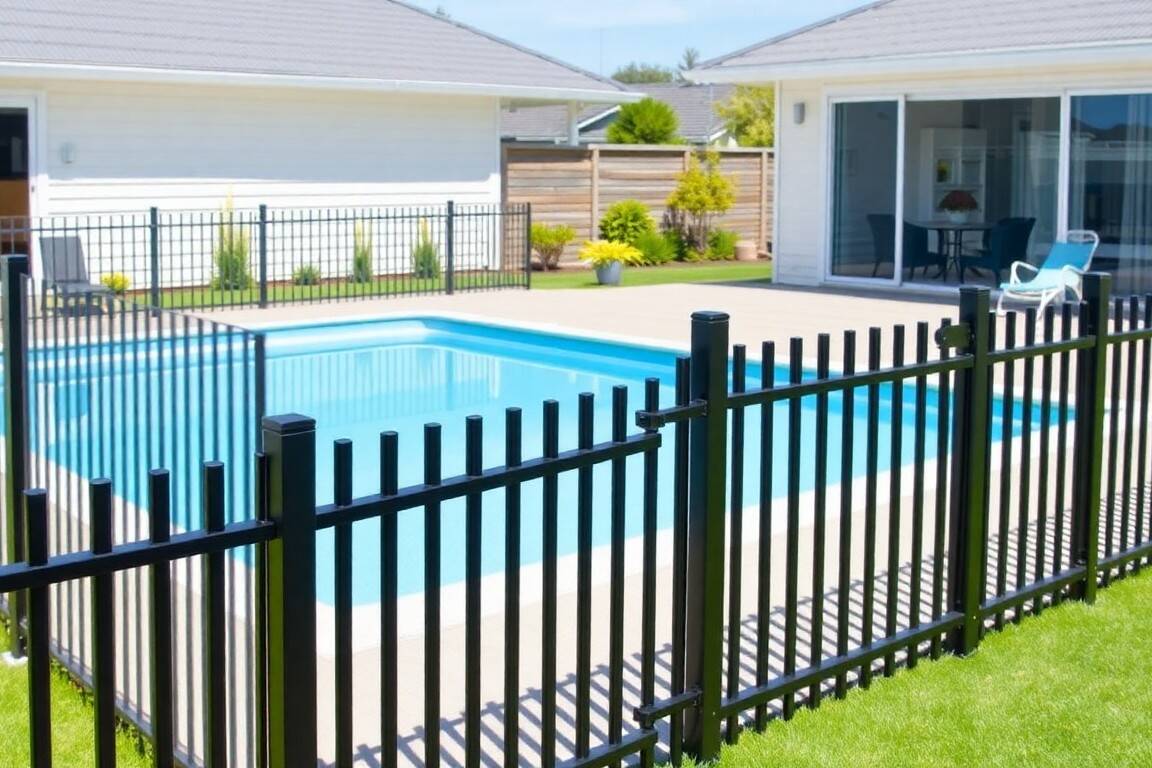
Aluminium is the default material for residential pool fencing in NZ. It is corrosion proof around chlorinated water, it meets the Fencing of Swimming Pools Act height and gap requirements in a standard modular panel, and it finishes clean in black or charcoal without visible weld points. See the pool fence range for compliant panels and gates.
Residential boundary fencing
For a modern home with a pool deck, tiled patio or a designed landscape, an aluminium boundary fence gives a cleaner, lower maintenance finish than colour steel or timber. Panels are available in privacy paling and slatted styles, and the black or charcoal finish disappears behind plants more gracefully than galvanised steel. See garden boundary fences.
Coastal and marina sites
Within 500m of the sea, aluminium is the safer structural pick. The fence finish stays clean for a decade or more, and the material itself does not pit or rust. Steel in the same location needs ongoing maintenance and usually a full refurbishment inside 15 years.
Driveway and pedestrian gates
Aluminium automated driveway gates stay light enough for a standard gate motor, which keeps the install cost lower and the motor lifespan longer. They do not sag with age the way a welded steel gate often does. Matching pedestrian gates in the same colour and profile make the streetscape consistent.
When steel is the right call
Commercial security
For a site that needs an anti climb, anti cut perimeter, steel weld mesh is the standard. Higher gauge panels resist bolt cutters and impact in a way aluminium does not match at the same panel cost. Commercial fencing often pairs a steel mesh run with aluminium gates where aesthetics matter at the entry point.
Rural and lifestyle block boundaries
Post and rail, wire mesh, chain wire and colour steel profile sheet all run longer and cheaper than aluminium on a rural boundary, and the aesthetic fits the land better than a modern aluminium panel. Where stock control is the main driver, steel wire products remain the standard.
Heavy duty gates
A large sliding gate or a heavy duty swing gate on a rural or industrial site often needs a welded steel frame to carry the load. Aluminium can do the same job in larger sections, but the weight saving is less valuable on a gate that already has a heavy motor drive.
Site fencing that moves
For construction sites, events and temporary perimeters, galvanised steel weld mesh in modular panels is the standard. See the temporary fence system for the full panel, foot, clamp and brace kit.
What about WPC, Colorsteel and timber?
Aluminium vs steel is the main debate, but it is not the only option on an NZ site. WPC (wood plastic composite) fencing delivers a timber look with a stable, rot free board, and works well as a privacy screen along a boundary. See the WPC fence range. Colorsteel profile sheet gives a rural, industrial look that neither aluminium nor standard steel mesh replaces. Timber remains the cheapest option for short lifespan fences, though it usually needs replacing at 10 to 15 years.
For a mixed property, it is common to run aluminium at the front and pool, colour steel along the rural boundary, and WPC around the service yard. That is usually the cheapest long term answer across a large section.
Buying aluminium or steel fencing in NZ
SD Aluminium stocks a full aluminium fence and gate system across residential, pool, commercial and WPC variants, plus galvanised steel sections for heavy duty and security runs. Manukau and Albany branches carry the range, with delivery across Auckland and NZ wide freight. Browse the aluminium fence and gate category for full panel, post and gate options, or contact the team to spec your project.
For a typical residential boundary and pool combination, the fastest answer comes from sending us your section dimensions, fence line length, and pool area. We will scope the panels, posts, gates and hardware in one quote.
FAQs
Which is cheaper in NZ, aluminium or steel fencing?
Upfront, steel is usually 15 to 30 percent cheaper per metre than aluminium for a like for like panel run. Once install speed and ten year maintenance are added, aluminium is often cheaper overall on residential and coastal projects. Steel still wins outright on rural, industrial and commercial security.
How long does an aluminium fence last in NZ?
A powder coated aluminium fence typically holds its finish for 20 to 25 years inland and 15 to 20 years on the coast. The aluminium itself does not corrode, so the structural life is usually much longer than the finish life.
Is aluminium fencing strong enough for a boundary?
For residential boundary fences, aluminium is more than strong enough. The panels are engineered to resist wind load, standard impact and climbing pressure. For high security commercial or anti intrusion fencing, steel weld mesh is the better pick.
Does aluminium fencing meet NZ pool fence law?
Aluminium pool fence panels from a reputable supplier are engineered to meet the Fencing of Swimming Pools Act and building code clause F9, including 1200mm minimum height, vertical bar spacing under 100mm, and a compliant self closing gate. Confirm the specific panel you order is certified for pool use.
Can you combine aluminium and steel fencing on one property?
Yes, and most mid to large NZ sections do. Aluminium at the front, pool and street facing areas, steel or colour steel along rural boundaries, WPC for privacy screening. Matching the material to the use is usually cheaper long term than running a single material everywhere.
Do aluminium fences need painting or finishing?
No. The powder coat applied at the factory is the finish, and it does not need painting, sealing or oiling. A rinse with water once or twice a year on coastal sites is the only routine maintenance. Damaged panels can be touched up with a matching paint or swapped out at the panel level.
What is the cheapest type of fence in NZ?
Timber post and rail remains the cheapest up front fence on NZ rural and boundary sites, but it has the shortest lifespan, typically 10 to 15 years. Colour steel profile sheet is cheaper than weld mesh and cheaper than aluminium, at around 15 to 20 years life. Aluminium is the dearest up front but the longest lived.
Related Posts

June 23, 2026
Pool Fence Regulations NZ: Compliance Checklist and Buying Guide
What NZ pool fence law requires: 1.2m height, 100mm gaps, a non climbable zone…